

In 1819, in the town of Kopust (Kopys), in present-day Belarus, a Chassidic work rolled off the printing press for the first time and quickly made waves throughout the Jewish world. More than two centuries later, it continues to inspire, uplift and transform the High Holiday experience of readers around the world.
The work, authored by the second Rebbe of Chabad, Rabbi Dovber Schneuri, was titled Derech Chaim u’Tochachos Musar Haskel, “The Path of Life and an Instructive Moral Rebuke.” Known simply as Derech Chaim, it is a treatise on repentance and prayer, illuminating these two forms of Divine service through the prism of Chassidic teachings, relatively new at the time.
The teachings of Rabbi Dovber, also known as the Mitteler Rebbe (“The Middle Rebbe”), are distinctive both in their style and in the form in which they were recorded and published. With the notable exception of Tanya—the seminal work of Chabad thought authored by the Mitteler Rebbe’s father and predecessor, Rabbi Schneur Zalman of Liadi—the vast majority of Chassidic teachings were delivered and transcribed as ma’amarim, or Chassidic discourses. These were generally self-contained, and even when several discourses formed a continuation, they often ranged across various subjects, incorporating themes from the weekly Torah portion or the Jewish holiday being observed.
The Mitteler Rebbe, by contrast, authored systematic treatises on Chassidic thought, each devoted to the methodical and extensive exploration of a particular subject. Among them are works on the unity of G‑d, repentance, holidays and other central themes.
Derech Chaim follows this model. It offers a systematic exploration of the gravity of sin and power of repentance, explaining the spiritual effect of sin on the individual and charting the path by which that damage can be repaired.
The fourth Chabad Rebbe—Rabbi Shmuel Schneerson, known as the Rebbe Maharash—once explained Derech Chaim’s unique value to his son and successor, Rabbi Sholom Dovber Schneerson, who would later become the fifth Rebbe:
To untangle the complexities of the soul’s garments of thought, speech and action, and to recognize one’s own strengths and shortcomings, one must study Grandfather’s Derech Chaim, carefully and deliberately. …
One can learn what they … are from many Chassidic discourses. But to understand how they … ought to be … and how those shortcomings can be corrected, for that one must study Derech Chaim.

Cornerstone of Teshuvah
Generations of Chassidim have regarded the work as a cornerstone of teshuvah and a guide to the process of genuinely returning to G‑d. It was studied especially during the Jewish month of Elul, which precedes the High Holidays and is a time particularly devoted to reflection, spiritual accounting, and return.
Reflecting its steady demand, the work was printed five times in Czarist Russia between 1819 and 1863. It was printed again in 1943 in Shanghai , where thousands of Jewish refugees from Nazi-occupied Poland had found refuge during the Holocaust.
Not long after his arrival in the United States in 1941, the man who would become the Seventh Rebbe—Rabbi Menachem M. Schneerson, of righteous memory—was appointed to head Kehot Publication Society, the Chabad-Lubavitch movement’s publishing arm which had been established by his father-in-law, the Sixth Rebbe, Rabbi Yosef Yitzchak Schneerson, of righteous memory. In that capacity, the Rebbe arranged for another edition of Derech Chaim to be printed in Shanghai in 1947, followed by subsequent editions in the United States. He also enriched the work by adding notes and indexes of his own authorship.
Demand for the work has not waned in recent years. Kehot published a new edition in 2002 and another in 2022, each incorporating additional material, notes and indexes.
“Sales of Derech Chaim have gone up 35% overall since we published the new edition in 2022,” says Rabbi Mendel Laine, director of sales at Kehot. “Of course, we also see a spike in sales every year as the month of Elul approaches.”

Growth for the Year
The tradition of study has also stayed strong. Each year, individuals and study groups turn to Derech Chaim and other classic Chassidic texts during Elul as part of their preparation for the High Holidays.
One such class is delivered annually by Rabbi Yechiel Krisch, a Chassidic scholar and lecturer in Monsey, N.Y. Held in one of the busiest synagogues in Monsey’s large Jewish community, it follows what he describes as a familiar pattern.
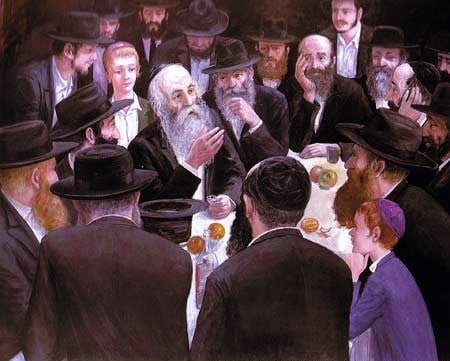
“The class takes place in a room where people are already sitting and studying,” he says. “We usually begin with about five people around the table. As the minutes pass, more and more people make their way over. By the time the class ends, there are often about 40 people sitting and standing around the table.”
He explains that Derech Chaim offers a perspective that can transform a person’s approach to the High Holidays and shape how their inspiration is carried into the rest of the year.
“If I had to summarize the entire book in a few short sentences, I would put it this way: Love of G‑d is very important, and awe of G‑d is crucial. But unless they are founded on kabbalat ol, accepting the yoke of Heaven and submitting oneself to Someone higher, everything else is only temporary,” Krisch explains.
“A day will come when you wake up and do not feel that love or awe. But if you are already committed, you will continue doing what is right on those days as well.”

Krisch says that throughout his youth and much of his adult life, Elul and Tishrei presented the same challenge: They were inevitably followed by the next10 months of the year. A person may become deeply inspired during the High Holidays and the days leading up to them, only to slip back into familiar routines once the year settles into its ordinary rhythm.
“Derech Chaim offers the solution,” he says. “It shows how to ensure that the entire year remains shaped by the inspiration with which it began.”
Krisch acknowledges that, for many, the idea of submitting to a Higher Power can seem overwhelming or carry a great deal of baggage. But that, he stresses, is not how the concept is presented in Derech Chaim.
“This isn’t your grandmother or school principal shouting at you to sit down and listen. It is a detailed explanation of how to give your personal, deeply felt spiritual service the power to last. It enables the change you were inspired to make on Rosh Hashanah to endure long after the shofar has been packed away and the synagogue put back together following the joyous dancing of Simchat Torah.
“Rosh Hashanah guarantees a certain degree of reawakening. Yom Kippur guarantees a return. Sukkot brings with it profound joy. Derech Chaim helps ensure that their effects last longer than the holiday meals.”
With Elul drawing to a close, completing the entire Derech Chaim, or even its first section, would be a considerable undertaking. But Krisch still recommends getting a taste of the work.
“The Mitteler Rebbe wrote an introduction to Derech Chaim that is almost a treatise in its own right,” he says. “If you can, study at least the introduction before the High Holidays begin. It will change the way you experience them.”
To purchase Derech Chaim, click here.





Start a Discussion